Text
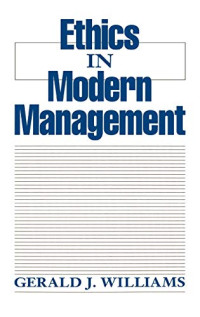
ETHICS IN MODERN MANAGEMENT
This book confronts business managers with media accounts of alleged ethical misconduct by business people and the low opinion the public has of the honesty of business people in general. Gerald J. Williams agrees that greed and self-interest are surely at work here, but he points out that these vices can be found in just about every area of human endeavor. He asks whether business people might think there is some special characteristic of the business enterprise that sometimes justifies acting in ways that would be considered immoral if they were done in nonbusiness situations. Does the impact, for instance, that a business may have on the economic welfare of its shareholders, employees, and the social and political communities in which it operates sometimes require its managers to follow a double ethic, one that applies to their business lives but not to their private lives? Not so, according to the author, who argues that there is no such thing as business ethics; there are only ethical principles applicable to all circumstances and conditions of human life. It is Williams' belief that only business people can restore their tarnished reputation by acting ethically, but that they have to first know something about moral theory and understand how different theoretical approaches to morality may yield different moral principles. Business people need to reflect on the set of moral principles they hold, conscientiously satisfy themselves that they are comfortable with those principles, and, if not, modify them and apply them consistently in both business and nonbusiness situations. This book is designed to help managers with the process of education and moral reflection by describing three approaches to morality: cultural moral relativism, utilitarianism, and Thomistic natural law. The book then goes on to show how each approach can address and attempt to solve concrete, real-life ethical conflicts in the business world. In short, the book offers a somewhat unique hands-on technique for teaching business ethics. It should interest business managers at all levles as well as teachers and students of business ethics.
Availability
| 10000363 | 174.4 WIL e | RLC MM (Rak Buku Umum) | Available |
Detail Information
- Series Title
-
-
- Statement of Responsibility
-
Gerald J. Williams
- Call Number
-
174.4 WIL e
- Publisher
- UNITED STATES : Greenwood Press., 1992
- Collation
-
xiv, 183 p. : ill ; 24cm.
- Language
-
English
- ISBN/ISSN
-
0-89930-707-8
- Classification
-
174.4
- Content Type
-
-
- Edition
-
-
- Subject(s)
- Specific Detail Info
-
-
Other version/related
No other version available
File Attachment
Comments
You must be logged in to post a comment
 Computer Science, Information & General Works
  Philosophy & Psychology
  Religion
  Social Sciences
  Language
  Pure Science
  Applied Sciences
  Art & Recreation
  Literature
  History & Geography