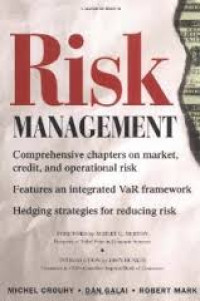
Text
RISK MANAGEMENT : COMPREHENSIVE CHAPTER ON MARKET, CREDIT, AND OPERATIONAL RISK
The traditional role of the risk manager as corporate steward is evolving as organizations face an
increasingly complex and uncertain future. The mandate to clearly identify, measure, manage, and
control risk has been expanded and integrated into best practice management of a bank. Today's risk
manager is a key member of the senior executive team who helps define business opportunities from
a risk-return perspective, presents unique ways of looking at them, has direct input into the
configuration of products and services, and ensures the transparency of all the risks. Innovation
necessitates new yardsticks for measuring and monitoring the resulting activities. The savvy
corporate leader uses risk management as both a sword and a shield.
At the end of the last millennium, financial institutions and investors experienced increased volatility
in the major financial and commodity markets, with many financial crises. At the start of the new
millennium, we are in the midst of a technological revolution resulting in changes in the operation of
markets, increased access to information, changes in the types of services available to investors, as
well as major changes in the production and distribution of financial services.
If there is concern about an institution's ability to manage risk, then its share price will be penalized.
Risk is a cost of doing business for a financial institution and consequently best practice risk
management is a benefit to our shareholders. To manage the risks facing an institution we must have
a clearly defined set of risk policies and the ability to measure risk. But what do we measure? And
how do we measure such risks? We must also have a best practice infrastructure. The starting point is
that we need a framework.
This book provides such a framework. The content of the book is consistent with our own risk
management strategy and experience. Our risk management strategy is designed to ensure that our
senior management operates together in partnership to control risk while ensuring the independence
of the risk management function. Improvements in analytic models and systems technology have greatly facilitated our ability to measure and manage risk. However, the new millennium brings new
challenges. There are risks that we can identify and measure and there is the uncertainty of the
unknown. The challenge facing risk managers is to minimize the consequences of the unknown. This
book should help all risk and business managers address the issues arising from risk and uncertainty.
Availability
| 10001361 | 658.155 CRO r | RLC MM (Rak Buku Wajib) | Available |
| 10001362 | 658.155 CRO r (1) | RLC MM (Rak Buku Wajib) | Available |
Detail Information
- Series Title
-
-
- Statement of Responsibility
-
Michael Crouhy
- Call Number
-
658.155 CRO r
- Publisher
- New York : New York : Mcgraw Hill., 2001
- Collation
-
xix, 717 p. : ill. ; 23 cm.
- Language
-
English
- ISBN/ISSN
-
-
- Classification
-
658.155
- Content Type
-
-
- Edition
-
-
- Subject(s)
- Specific Detail Info
-
-
Other version/related
No other version available
File Attachment
Comments
You must be logged in to post a comment
 Computer Science, Information & General Works
  Philosophy & Psychology
  Religion
  Social Sciences
  Language
  Pure Science
  Applied Sciences
  Art & Recreation
  Literature
  History & Geography